Four Common Tax Scams Aimed at American Taxpayers
If you are a US taxpayer, it’s important to be aware of the fact that criminals are seeking to steal your money. Below are four common tax scams which are frequently targeted toward American taxpayers.
Taxpayer Advocacy Panel Scam
Criminals are targeting US taxpayers by sending email messages that appear to be from the Taxpayer Advocacy Panel. The email entices taxpayers to provide their personal information so that they may receive an update on their tax refund. Don’t respond or click on any links in these emails.
IRS Agent Impersonation
A number of criminals call taxpayers claiming to be IRS agents. These criminals typically use aggressive tactics, such as threats of financial penalties and jail time in order to get unsuspecting taxpayers to pay up. However, they may also use softer tactics in an effort to get taxpayers to provide them with personal financial information or a Social Security number.
Payroll and HR Scams
Another email scam involves sending emails to HR and payroll professionals claiming to be the CEO or executive of the company they serve. The email requests the personal information and Social Security numbers of employees.
Inflated Tax Refund
Taxpayers should be aware of tax preparers who make claims about outlandish refund amounts. Criminals routinely pose as tax preparers and promise their victims a large tax refund. They charge exorbitant fees for their services, and they most often steal a taxpayer’s personal information in order to receive a false refund.
Don’t fall for these financially devastating criminal operations.
Image credit: Bart
The ABCs of Determining the Square Footage of Your Home Office for Tax Purposes
Small business owners, who have a designated office space in which to operate their business, are eligible to claim a portion of the mortgage and other home expenses on their taxes. However, you can only claim this deduction if you know the square footage of your home which is designated as your office space.
How to Determine Your Home Office Square Footage
In order to determine the percentage you can deduct from your mortgage and other home expenses, simply divide the square footage of your home office space against the total square footage of your home. If your office space is 135 square feet, and your house is 1,400 square feet, this means that you can deduct a total of 9% of the cost of your mortgage and utilities. Using this simplified equation is the best way to get an accurate sense of your percentage.
If the room you use for your home office is identical in size to your other rooms, you can use another method to determine your percentage. Simply divide the number of rooms you use for your business by the total amount of rooms in your house.
Currently, the IRS allows $5 per square foot. However, be aware that you can only claim up to 300 square feet of your home for this purpose.
Home Office Advantage
Qualifying for this deduction can be well worth it as the payoff is significant. However, you cannot use the home office for any other purpose.
If you are thinking about the home office space deduction, please consider it carefully.
Image credit: Blue
How to Pick the Right Investment to Offset a Capital Loss
It’s important to know how to offset your losses with the right investments. You need to carefully consider which investments are best to sell for taxes purposes. In this brief article, we will cover what your best options are in order to turn your loss into a gain.
Selling the Right Investments
The rule of thumb in investment games for taxes is to sell off investments which do not meet your investment goals. You should never sell an investment simply because the price has dropped. Consider the criteria of a sound investment value.
What Makes a Sound Value?
Market conditions are always in fluctuation. As a result, when an investment drops in price you need to evaluate what the market conditions are and how they are going to affect the value of your investment over the course of time. Investments which are negatively impacted over the long term when market conditions change are best to sell, while other investments, whose long term value are still viable despite market fluctuations, are best to keep in your portfolio.
Harvesting Your Tax Loss
By selling the investments that have lost value, you can significantly reduce your tax burden on the capital gains you win from your investments. Determining this is as simple as looking at depreciated investments which no longer possess positive prospects for growth.
When it comes to picking the right investment to offset a capital loss, know your investment strategy. Never sell an investment if possesses potential value in your portfolio.
Image credit: Got Credit
Why Dying Without a Will Doesn’t Make Taxes Disappear
Death does not automatically void your tax liability. There are still taxes associated with your time on earth in the current tax year. The task of filing your return is put on your next-of-kin since you are no longer present to file it yourself.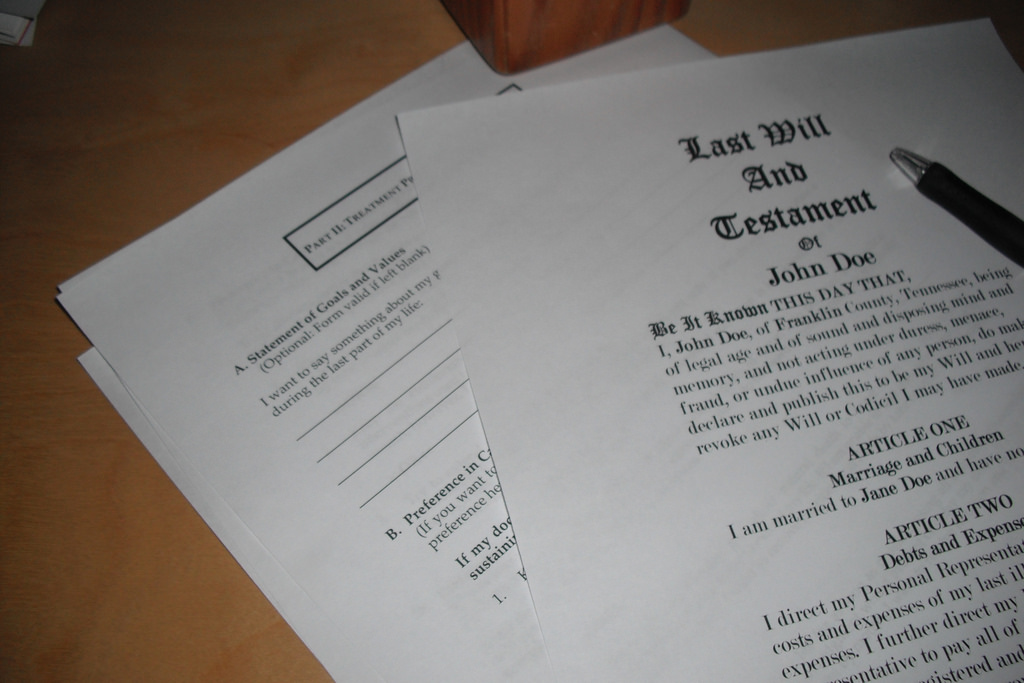
Personal Income Tax
If you had taxable income in the year of your death, a tax return must still be filed. It may result in a refund issued, which would have to be handled by your next-of-kin. When filing the return, it is also best to include a copy of the death certificate as proof, since the government will ask for it anyway.
Capital Gains and Losses
Businessmen and women who have investments, stocks and mutual funds may experience capital gains and losses. If these investments (assets) are not assigned to a family member, you are still responsible for the taxes on them, even though you are deceased. It is a good idea to gift the investment to a family member with the stipulation that they take ownership upon your passing only.
Estate Taxes
Your estate, meaning your home, assets and verifiable available monies are taxable. Most families hold estate sales and auctions. The property still incurs property tax, vehicles still have registration costs and properties still have values.
Bottom Line
Even upon your death, taxes are still required to be filed. Some matters, such as an estate which is questioned in probate court, can take years to settle. It is always a good idea to have a will in place. If you do not have a formal will, at least have something written down that explains how you intend to disburse your possessions following your death.
Image credit: Ken Mayer
Should America Be Expecting a Tax Increase in the Future?
Americans should expect some sort of tax increase within the next decade. Most of this hangs in the balance of the upcoming Presidential election. Republicans wish to lower taxes and democrats wish to increase taxes, while providing other services. In the United States, personal income and corporate tax rates are expected to fluctuate, although citizens and business owners would both prefer to see them decrease.
2016 Election Dependent
Whether or not the American people are going to see an increase in taxes is heavily dependent on who becomes the nation’s next president. If a Democrat is elected, Americans can expect to see an increase in personal income and corporate taxes, although it will be higher if Bernie Sanders is elected.
Republican candidates have plans to reduce taxes. Donald Trump plans to lower personal and corporate income taxes to flat rates hovering around 15 percent. Ted Cruz and John Kasich also have plans to lower taxes.
National Debt Reduction
An increase in taxes is said to be what the nation needs to reduce the national debt. Our nation is currently sitting at a 74 percent gross domestic product. The smallest GDP recorded since WWII was 23 percent in 1974.
Bottom Line
Closing the gap on the national debt has to come from somewhere, and the government refuses to cut frivolous spending. Taxes must be raised to make up for it. Rising taxes is not simply a matter of having a larger budget for its own sake; it is about working toward reducing national debt and stabilizing the economy over time.
Image credit: Susannah Storch
Should You Pay Your Taxes with Your Credit Card?
While you should have the necessary funds in a traditional bank account to pay your tax liabilities, this is not always an option. You cannot use a debit card to pay your taxes, but credit cards are accepted. The drawback of using a credit card is that you have to pay back the credit card company plus interest; this ultimately results in a higher cost.
Personal Credit Card Interest Not Tax Deductible
Interest accrued on personal credit cards for tax payment purposes is not tax deductible. The only credit card interest that is tax deductible is when the expense is for a business purpose, and this must be documented. Obtain a statement from your credit card company for tax purposes to determine the actual amount of business expense interest that was paid.
Small Tax Debt
Now, if you only owe a small amount of taxes, using a credit card is okay. However, at the same time, you should only use the credit card if you will be able to pay the balance off in-full at statement time, or before the bill even comes.
Use Only Zero Interest Accounts
Only pay your taxes with a credit card if it is a zero interest account. Otherwise, you end up paying more than you owed to begin with. This doesn’t make much sense, but for some individuals, it is the only option.
Closing Thoughts
Only use your credit card to pay your taxes if you have no other choice. If you end up having to make payments to the IRS and a credit card, you’re really getting hit with a double whammy. You end up paying one and half times (minimally) your original debt owed.
Image credit: Håkan Dahlström
3 Reasons Not to Lower Your Taxes
It may seem like backwards reasoning to not lower your tax liability, but it really is for the best in terms of having more money available for retirement and capital investment. There is a right time and place to lower your taxes. This should also be done carefully and in the right sectors of your financial portfolio. But there are scenarios in which lowering your general tax liability is not the best option. Below we will highlight reasons for why lowering your liability may not be preferable.
Roth IRA and 401K
When you work with Roth IRAs and 401K retirement savings plans, you have more money available at retirement. The younger you begin your Roth accounts, the more funds you will have available. It can also reduce your tax liability in retirement, and that is when you need those funds the most.
Deliberately Offset Capital Losses
Depending on your financial situation, intentionally offsetting a capital loss with a gain may be the right idea. A capital gain is defined as profiting from the purchase of stocks, investments or other appreciating assets. A capital loss is the opposite. Canceling out a loss may be the right option.
Gift Assets
Consider gifting substantial assets to children. The future income derived from those assets is taxed at a lower rate upon selling the asset. Unearned income tax applies to earnings over $2100. Gifted assets are taxed at the “kiddie tax” and “child tax” rates rather than the rates which apply to traditional capital gains, profit and income.
Closing Thoughts
What it boils down to is that lowering your tax liability may turn around to cause trouble later. Keep your tax liabilities where they are and do not lower your income, shift assets or make harsh decisions until you have spoken with your financial advisor to ensure that it is the right move.
Image credit: Got Credit
How to Reduce Your Capital Gains Taxes
Capital gains are distinct from income. This is income earned from the sale of assets, stocks or investments. If your primary income is from capital gains, making several payments to the IRS a year may be a good idea. In other words, it may be beneficial to follow similar practices as those who are self-employed year round.
Do Not Sell for 1 Year
Hold your investments for at least one year. Once an investment hits the one-year mark, it is seen as a long-term investment. This reduces the tax percentage you would pay, thus reducing the overall tax burden.
Sell During Financial Difficulty
Your overall income plays a role in the amount of long-term capital gains tax that you pay. Those in the 35-percent and below brackets pay 15-percent capital gains tax. Higher tax brackets pay 20-percent. Selling when you are low on income or experiencing a major financial loss like retirement, will allow you to lessen the amount of tax owed.
Leave Investments to Family
Never sell your investments and leave them to a family member in your will. If the family member sells the investment, taxes will not be due on the previous years’ gains reports or the gains from the date you purchased the investment.
There are over one dozen ways to avoid paying capital gains taxes altogether. It requires meticulous record keeping, moving a lot and making the right financial decisions. The assistance of a financial advisor can help you keep your capital gains taxes to a minimum.
Image credit: Lendingmemo.com
How Back Taxes May Literally Ground You
Owing taxes isn’t a big deal if you work them out as soon as you realize that you owe. Often, you can pay your taxes quarterly or take a small amount in penalties for paying slightly late as long as you come to an agreement with the IRS. If you owe back taxes and they have not been worked out, this can develop into a big issue down the line. Here are some consequences which may result from owing back taxes.
Getting a Lien on Your Home
Buying your home is something that you are likely proud of. The IRS can put a lien on your best possession if you do not pay your tax debts. This means that the sale of your home will result in money going into the hands of the IRS first. If your home sale is not as much as you were expecting, this can result in money still being owed after the sale of a home.
Paycheck Garnishment
Owing the government is a quick way to get your paycheck garnished. The process of getting payments garnished from the government versus private companies is much easier. If you are trying to get yourself together financially, this can cause a shutdown of any of your personal plans.
No Passport
There never used to be any issues with getting a passport due to money, other than child support cases. As of 2016, if you owe at or around $50,000 in taxes, the IRS has the ability to seize your passport. This means no more trips to see family or friends out of the country and no more overseas vacations until your tax debt has been settled.
Image credit: reynermedia
How to Save on Income Taxes When Selling Your Home
Capital gains taxes are some of the highest taxes that you can pay. If you are planning on selling a home, you may be in for a shock with the amount of tax you owe from the sale of a home. Fortunately, if you are selling a residence that you own, there are ways that you can decrease the amount that you owe in taxes. Here are some ways to cut the amount that you owe in taxes after netting a home sale.
Own and Live in the Home
In order to deduct the amount of a home sale up to one half of one million dollars, you must own and live in the home. You must live in the home for two years prior to the sale to utilize this deduction. You must also own the home for at least two years in order to write off the amount of the sale. If you are planning to sell one of your residences at some point in the future, set up inside of the unit as your principal residence for at least 24 months. This will allow you to sell off the unit without potential major tax issues.
Save by Being Married
If you are married, you can write off up to $500,000 on a home sale. If you are a single person, you can write-off at least $250,000 for the sale of your home. If you are already planning to get married, you should have the wedding first and then subsequently make the sale once you can file jointly to save as much cash as possible.
Image credit: woodleywonderworks


